Posts

Week 7

I got right back into the swing of things this week, and learned how to perform even more procedures as my project progresses. On Monday, my mentor told me that he had already gone ahead and sent in the previous week's samples for sequencing (the final step of the cloning process) during my hiatus. The results hadn't arrived yet, though, so I instead practiced the next step: in vitro  transcription. Although DNA is the ultimate blueprint for making proteins and therefore organisms, it is not actually directly translated into them. That role belongs to an intermediate molecule known as RNA, which is produced in the cell's nucleus using DNA as a template. After RNA is translated into proteins, it breaks down, halting the production of proteins but leaving the original DNA unaffected. What we had at that point was DNA; injecting it into the egg cells would do nothing, as the cell would continue to only express the DNA in its original genome. However, RNA  would be i...
Week 6

Image
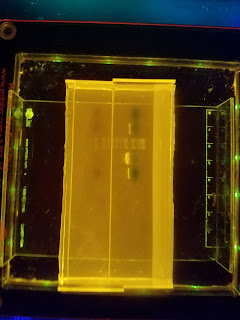
Hey, everyone! Short post this week, as I only went in on Monday and took the rest of the week off for spring break. I retrieved the plate that I had inoculated on Friday, which now had several bacterial colonies visibly growing. If you remember, these bacteria contained the one type of DNA which hadn't worked last week. I amplified that DNA using PCR, which took up most of the day. I then ran what is hopefully the last-ever gel on the products and, to my relief, the results were successful! Now that we finally had all the DNA we needed, I chose two colonies from each plate (based on previous gels) and cultured them. The last step will be to isolate the DNA and send it to another lab for sequencing, which will serve as the final confirmation. See you next week!

Week 5

I nearly finished the cloning process this week but ran into my first bout of trouble. No project would be fun without a challenge, though, which is exactly what I encountered. Most of the week was spent diagnosing then attempting a solution-- whether it works remains to be seen when I return! -------------------------------------------------------------------------------------------------------------------------- On Monday, I ran a gel on the DNA that was sitting in the fridge over the weekend (if you haven't noticed, I do a lot  of gel electrophoresis, as the DNA has to be verified as correct after every step of the FastCloning process). Oddly, nothing showed up in the gel. I checked everything about the gel setup itself (including the agarose solution, this time), but nothing was wrong, meaning the DNA was the culprit. Dr. Chang suggested that I amplify the DNA-- maybe the issue was that there simply wasn't enough of it. I spent the rest of the afternoon preparing ...

Week 4

Image
I got right back to work this week after my mentor arrived from Minneapolis on Monday. The final DNA sequences had finally arrived while we were out, so we began the process of molecular cloning: inserting the sequences into plasmids (larger, circular DNA fragments that carry the desired sequences), coaxing some bacteria into taking in and naturally reproducing the plasmids, and finally purifying the "cloned" DNA product. This can be done in a variety of ways, but many traditional methods involve expensive kits or have an unacceptable risk of mutation. So we used FastCloning, an inexpensive and effective method that my mentor developed and published in 2011. It carries that name because it is faster than the aforementioned methods; however, as I was about to discover, it is still very time-consuming (at least with my lack of experience). This one's a bit of a doozy; consider it as a supplement to last week's incredibly short one. ---------------------------------...

Week 3

This week, my mentor was in Minneapolis visiting his family, so I couldn't be in the lab (due to Barrow policy). Instead, I read some more of the articles he sent me about nicotinic acetylcholine receptors. They're not easy to read, as I don't have a Ph. D in molecular neuroscience, but I got through most of them with the help of Google. Additionally, I read up on the cloning method that we will be performing when I return: FastCloning, which was developed by a team that my mentor was actually a member of. Dr. Chang will arrive Monday night, so I'll be back to work on Tuesday!

Week 2

Image
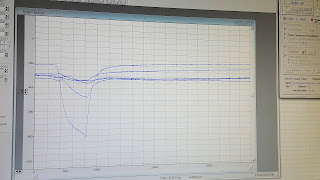
Hey, everyone! I'm back with another weekly summary of my activities at BNI. The materials for my project finally arrived this week! We started preparing them while working on the zinc-activated ion channel project that I was working on last week . On Monday, I continued collecting data from the oocytes using the voltage clamp and the same chemicals. Although we were getting consistent responses from some of the eggs, they were definitely less robust, and most of the eggs did not produce any response at all. This was most probably because the eggs had weakened over the weekend, as they had been originally injected with the ion channel DNA one whole week ago. What the reading from the voltage clamp looks like on the computer. The troughs indicate activation of the zinc-activated ion channels due to various concentrations of the surrounding solution. On Tuesday, we attended a luncheon/presentation at Barrow about the production and usage of research-grade cigarette...

Week 1

Image
Yesterday concluded my very first week working as a volunteer researcher at Dr. Yongchang Chang's laboratory at Barrow Neurological Institute! It was truly fascinating to see (and perform) current research in the neuroscientific field rather than reading about it in a decade-old textbook. I especially enjoyed using the highly specialized equipment that can't be found in any high school lab (and appreciated that he let me use it at all). All in all, I am really looking forward to the remaining nine weeks. Here is a summary of my daily activities, simplified for readability and confidentiality (this research is not yet published.) As of now, the materials for my specific project have not yet arrived, so I spent this week assisting Dr. Chang with another topic he is currently researching. On Monday, he explained to me this topic of study: zinc-activated ion channels, which are present in the human brain, spinal chord, lungs, kidneys, and many other regions. Very little is kn...